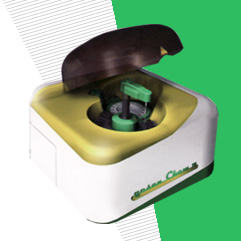

Technical Specifications
Power Supply:
240/100 Vac, 50/60 Hrz, single phase with ground On-off switch for Instrument. Independent on-off switch for refrigerated reagant plate. Power consumption: less than 200 VA (external PC excluded).
Sampling Arm:
1 sampling needle, 110 mm needle stroke. Capacitive liquid level detector Needle shock sensor. Reagent preheat reel.
Diluter Syringe:
Long life ceramic plunger. Syringe capacity, 500μl Syringe resolution, 038 μl.
Hydrauuc System:
8 self-priming peristaltic pumps (life 1000 hrs) with replaceable neoprene cassette (life 500 hrs) 2 vacuum pumps, Pinch valve, Manifold Container: Water, 20 l; Cleaning solution, 2 l; Waste, 20 l. equipped with level sensor and sefaty connections.
Wash Station:
Needles: 6 dispensating, 6 aspiration, 1 clearing (8 step washing sequence for each cuvette).
Reagents Tray:
Refrigerate and removable rack, 18 or 27 bottles.
Samples Tray:
(Chem 200 standard) Removable tray, 60 numbered positions, tubes of 12-13 mm, 5-7 mi/ cups of 0.5-1.5ml. (Optional) Removable tray, 20 + 20 numbered positions, 20 tubes of 12 - 16 mm/ 20 cups (Hitachi type).
Cuvette Rotor Reaction Celles:
80 washable BIONEX cuvettes which allow approximately 20.000 tests for a fully loaded rotor Optic path 6 mm, 220 - 400 ul reaction volume 100W heating resistance, temperature sensor, safety thermostat.
Optical Group:
1 halogen lamp (6 V, 10 V) with extended UV emission 2 focusing lenses, optical glass 10-position filter disk: 8 positions provided with Interference filters of 340, 405, 505, 546, 578, 600, 650, 700 nm wavelenghts, 1 free position and 1 solid position for dark reading.
Direct reading reaction cuvettes, 6 mm optical path ±2 nm on peak wavelength, band pass of ± 10nm.
Photoamplifier:
Photoelectric detector, Signal amplifier: Response range, 340 nm to 900 nm Photometric range, O to 2.0 Abs ±0.003 Abs Linearity, ±0,5% full scale. Precision: 1 CV% (0.050 to 1500 Abs). Stability: daily reader offset, less than 1% drift for day.
Control:
Rea-time multitasking microprocessor based control. Easy access to the electronics.
External Computer:
(Minimum requirements) Intel Pentium IV family with 2 GHz, 20 Gb HD, 512 Mb ram, CD/R 17” monitor, 1280x1024 resolution. Keyboard and mouse RS232 standard COM1 serial port Windows XP pro with, NET framework 2.0
Operational features
Sample Diluition:
In-needle diluition if allowed by method’s sample volumes. Automatic pre-dilution in a reaction cuvette, up to 1:100
Temperature Control:
Reagent refrigeration, about -15 C below room temperature. Reagent preheating reel, O to 100% heat setting. Reaction cells, heating unit can be set from room temperature up to 42 C ±0.2 C (108 F ± 0.5 F)
Types Of Tests:
Endpoint, Bichromatic endpoint, Differnetial endpoint, Differential endpoint sample blank, Fixed Time, Kinetic.
Test Runs:
Urgent/ random
Measurement Rates:
225 tests/hour for double reagent run Maximum incubation + reading time:single reagent mode, one reading every 20 sec double reagent mode, one reading every 24 sec. Typical precision, endpoint 2.5 CV5 / kinetic 2.5 CV%. Carry-over, lower than 15 parts per mllion.
Start-up:
The start-up procedure is run at power-on: self-test, reader offset of optics, wash and check of all cuvettes.
Calibration: reagent blank subtraction, 1 to 8 standards per test method Linear: factor, linear regression (standard’s repetitions) Non linear (3 interpolation types): cubic-spline, poly-linear and logit-log four parameters. Free standard/ control positions on all the sample plate Result can be recalculated when changing factor or curve.
Maintenance:
Procedures programmed by componet life counters.
Printing Report:
Single test, complete sample, work sheet, method and GCs. Automatic sample reports upon test completion if requested.
Needle Washing:
Sampling needle washed internally and extenally with System solution after every operation.



Clinical Chemistry Autoanalyser